Manipulating an SED object
SED objects represent SED templates belonging to one of the three possible classes “STAR”, “QSO” (for AGN type of objects), and “GAL” for galaxies. SED templates available with LePhare can be found under the sed directory.
The notebook can be downloaded here.
[1]:
import os
import lephare as lp
import numpy as np
from matplotlib import pylab as plt
import struct

%matplotlib inline
%load_ext wurlitzer
LEPHAREDIR is being set to the default cache directory:
/home/docs/.cache/lephare/data
More than 1Gb may be written there.
LEPHAREWORK is being set to the default cache directory:
/home/docs/.cache/lephare/work
Default work cache is already linked.
This is linked to the run directory:
/home/docs/.cache/lephare/runs/20260701T060402
[2]:
keymap = lp.all_types_to_keymap(lp.default_cosmos_config)
# Get the auxiliary files required.
lp.data_retrieval.get_auxiliary_data(keymap=keymap, additional_files=["sed/STAR/PICKLES/f2ii.sed"])
Registry file downloaded and saved as data_registry.txt.
Downloading file 'sed/STAR/PICKLES/f2ii.sed' from 'https://raw.githubusercontent.com/lephare-photoz/lephare-data/main/sed/STAR/PICKLES/f2ii.sed' to '/home/docs/.cache/lephare/data'.
Checking/downloading 445 files...
445 completed.
All files downloaded successfully and are non-empty.
Checking/downloading 1 files...
1 completed.
All files downloaded successfully and are non-empty.
[3]:
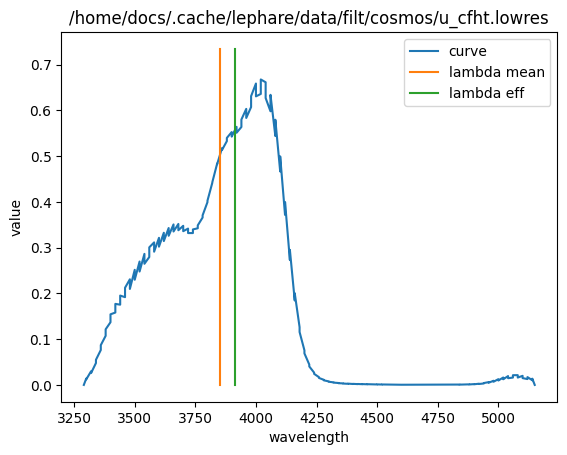
filter_name = "cosmos/u_cfht.lowres"
f1 = lp.flt(0, filter_name, 1, 0)
f1.read(os.path.join(lp.LEPHAREDIR, "filt", filter_name))
f1.plot_filter_curve()
[4]:
# we can write the config to a file to keep a record
config_file = "./config_file.para"
lp.write_para_config(keymap, config_file)
# before running PhotoZ we must run filt, sedtolib and maggal
filter_driver = lp.Filter(config_file=config_file)
filter_driver.run()
[4]:
[<lephare._lephare.flt at 0x7789fd1d76a0>,
 <lephare._lephare.flt at 0x7789fd1d7c40>,
 <lephare._lephare.flt at 0x7789fd1d79c0>,
 <lephare._lephare.flt at 0x7789fd1d7ce0>,
 <lephare._lephare.flt at 0x7789ea13ae80>,
 <lephare._lephare.flt at 0x7789ea13ac00>,
 <lephare._lephare.flt at 0x7789ea13aed0>,
 <lephare._lephare.flt at 0x7789ea13af20>,
 <lephare._lephare.flt at 0x7789ea13af70>,
 <lephare._lephare.flt at 0x7789ea13afc0>,
 <lephare._lephare.flt at 0x7789ea13b010>,
 <lephare._lephare.flt at 0x7789ea13b060>,
 <lephare._lephare.flt at 0x7789ea13b0b0>,
 <lephare._lephare.flt at 0x7789ea13b100>,
 <lephare._lephare.flt at 0x7789ea13b150>,
 <lephare._lephare.flt at 0x7789ea13b1a0>,
 <lephare._lephare.flt at 0x7789ea13b1f0>,
 <lephare._lephare.flt at 0x7789ea13b240>,
 <lephare._lephare.flt at 0x7789ea13b290>,
 <lephare._lephare.flt at 0x7789ea13b2e0>,
 <lephare._lephare.flt at 0x7789ea13b330>,
 <lephare._lephare.flt at 0x7789ea13b380>,
 <lephare._lephare.flt at 0x7789ea13b3d0>,
 <lephare._lephare.flt at 0x7789ea13b420>,
 <lephare._lephare.flt at 0x7789ea13b470>,
 <lephare._lephare.flt at 0x7789ea13b4c0>,
 <lephare._lephare.flt at 0x7789ea13b510>,
 <lephare._lephare.flt at 0x7789ea13b560>,
 <lephare._lephare.flt at 0x7789ea13b5b0>,
 <lephare._lephare.flt at 0x7789ea13b600>]
[5]:
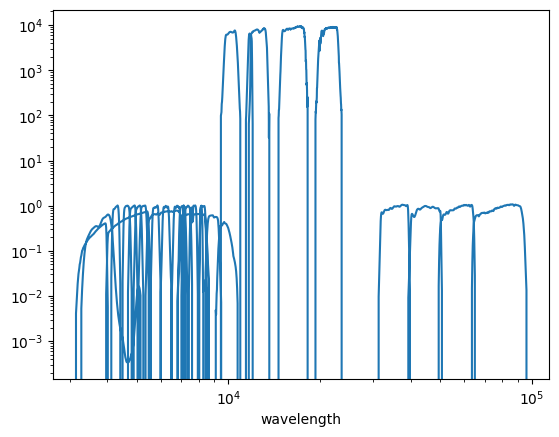
filter_output = os.path.join(
    os.environ["LEPHAREWORK"], "filt", filter_driver.keymap["FILTER_FILE"].value + ".dat"
)
filters = np.loadtxt(filter_output, dtype={"names": ("lamb", "val", "bid"), "formats": (float, float, int)})
plt.loglog(filters["lamb"], filters["val"])
plt.xlabel("wavelength");
[6]:
!ls $LEPHAREDIR/sed
GAL QSO STAR
Let’s start with the template of a star. A SED object is created most easily with 3 arguments: its name, an identifying integer, and the type it belongs to. Then calling the read function reads the ASCII file passed as argument.
[7]:
star_sed = "f2ii.sed"
sed_filename = os.path.join(lp.LEPHAREDIR, "sed/STAR/PICKLES/", star_sed)
sed = lp.StarSED(star_sed, 1)
sed.read(sed_filename)
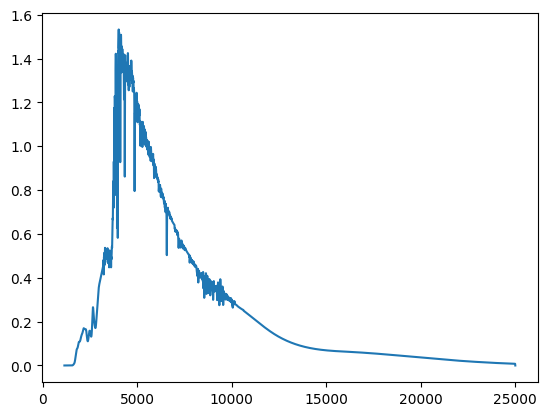
The python code exposes the templates vectors through the data method
[8]:
x = sed.data()[0]
y = sed.data()[1]
plt.plot(x, y)
[8]:
[<matplotlib.lines.Line2D at 0x7789ea2e4dc0>]
In the context of LePhare, such a SED object is going to be written as a byte compressed file, and read back downstream to compute expected magnitudes and to perform the fit. Writing an reading this binary stored file goes as follows:
[9]:
rootname = star_sed.split(".")[0]
sed.writeSED(rootname + ".bin", rootname + ".phys", rootname + ".doc")
We can read it back into a new SED object, and check that the values have been correctly read back
[10]:
sed2 = lp.StarSED(star_sed, 2)
sed2.readSEDBin(rootname + ".bin")
x2 = sed.data()[0]
y2 = sed.data()[1]
assert np.all(x == x2)
assert np.all(y == y2)
print(sed.name, sed2.name)
f2ii.sed MOD_1
[11]:
sed = lp.Sedtolib(config_file)
sed.run(typ="STAR", star_sed=f"{lp.LEPHAREDIR}/sed/STAR/STAR_MOD_ALL.list", star_fscale="1")
[12]:
sed_output = os.path.join(os.environ["LEPHAREWORK"], "lib_bin", keymap["STAR_LIB"].value + ".bin")
[13]:
sed_output
[13]:
'/home/docs/.cache/lephare/work/lib_bin/LIB_STAR.bin'
[14]:
# Code to unpack binary not running
# buf = open(sed_output, "rb").read()
# counter = 0
# off = 0
# while counter <= 0:
#     nrec, jtype, nbw = struct.unpack("iil", buf[off : off + 16])
#     wave = struct.unpack("d" * nbw, buf[off + 16 : off + 16 + 8 * nbw])
#     print(nrec, jtype, nbw)
#     off += 16 + 8 * nbw
#     nrec, jtype, nbw = struct.unpack("iil", buf[off : off + 16])
#     spec = struct.unpack("d" * nbw, buf[off + 16 : off + 16 + 8 * nbw])
#     print(nrec, jtype, nbw)
#     off += 16 + 8 * nbw
#     counter += 1
# plt.plot(wave, spec)
# # plt.xlim(1000,1.e4)
# # plt.ylim(1.e-10,1.e-6)

# n = 6973
# struct.unpack("d", buf[off + 16 + 8 * (n - 1) : off + 16 + 8 * n])

# nbw

# buf[38896 + 16 + 8 : 38896 + 16 + 16]

# struct.unpack("d", buf[38896 + 16 + 8 : 38896 + 16 + 16])

# print(4.2399775704000006e-08 / 1.23542470e01)

# struct.unpack("d" * 1, buf[off + 16 : off + 16 + 8])

# struct.calcsize("l")

# wave[1], spec[1]
[15]:
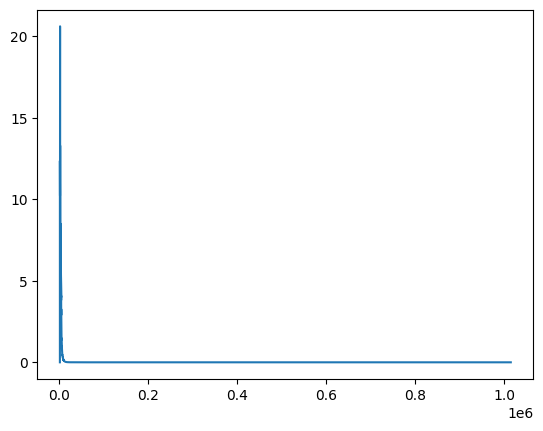
d = np.loadtxt(f"{lp.LEPHAREDIR}/sed/STAR/PICKLES/o5v.sed.ext")
plt.plot(d[:, 0], d[:, 1])
[15]:
[<matplotlib.lines.Line2D at 0x7789ea337be0>]
[16]:
d[:, 1]
[16]:
array([0.00000000e+00, 1.23542470e+01, 9.92826800e+00, ...,
       2.15824600e-65, 4.93845048e-66, 1.13000525e-66], shape=(4860,))
[17]:
stream_buf = open(sed_output, "rb").read()
[18]:
struct.unpack("iil", stream_buf[0:16])
[18]:
(1, 4860, 0)
[19]:
k = lp.keyword("TEST", "0.1,0.1,6")
print(k.split_double("0.03", 3))
print(k.split_double("0.03", 3))
[0.1, 0.1, 6.0]
[0.1, 0.1, 6.0]
[20]:
mag = lp.MagGal(config_file)
mag.run(typ="STAR", lib_ascii="YES", star_lib_out="ALLSTAR_COSMOS")
[21]:
sed.run(typ="QSO", qso_sed=f"{lp.LEPHAREDIR}/sed/QSO/SALVATO09/AGN_MOD.list")
[22]:
sed.run(typ="GAL", gal_sed=f"{lp.LEPHAREDIR}/sed/GAL/COSMOS_SED/COSMOS_MOD.list", gal_lib="LIB_VISTA")
[23]:
mag = lp.MagGal(config_file)
mag.run(
    typ="QSO",
    lib_ascii="NO",
    mod_extinc="0,1000",
    eb_v="0.,0.1,0.2,0.3",
    extinc_law="SB_calzetti.dat",
    z_step="0.04,0,6",
    verbose=True,
)